
Fire Extinguisher Service for Monroeville-Area Businesses: The NFPA 10 Clock
By Casey White, Owner · · 6 min read
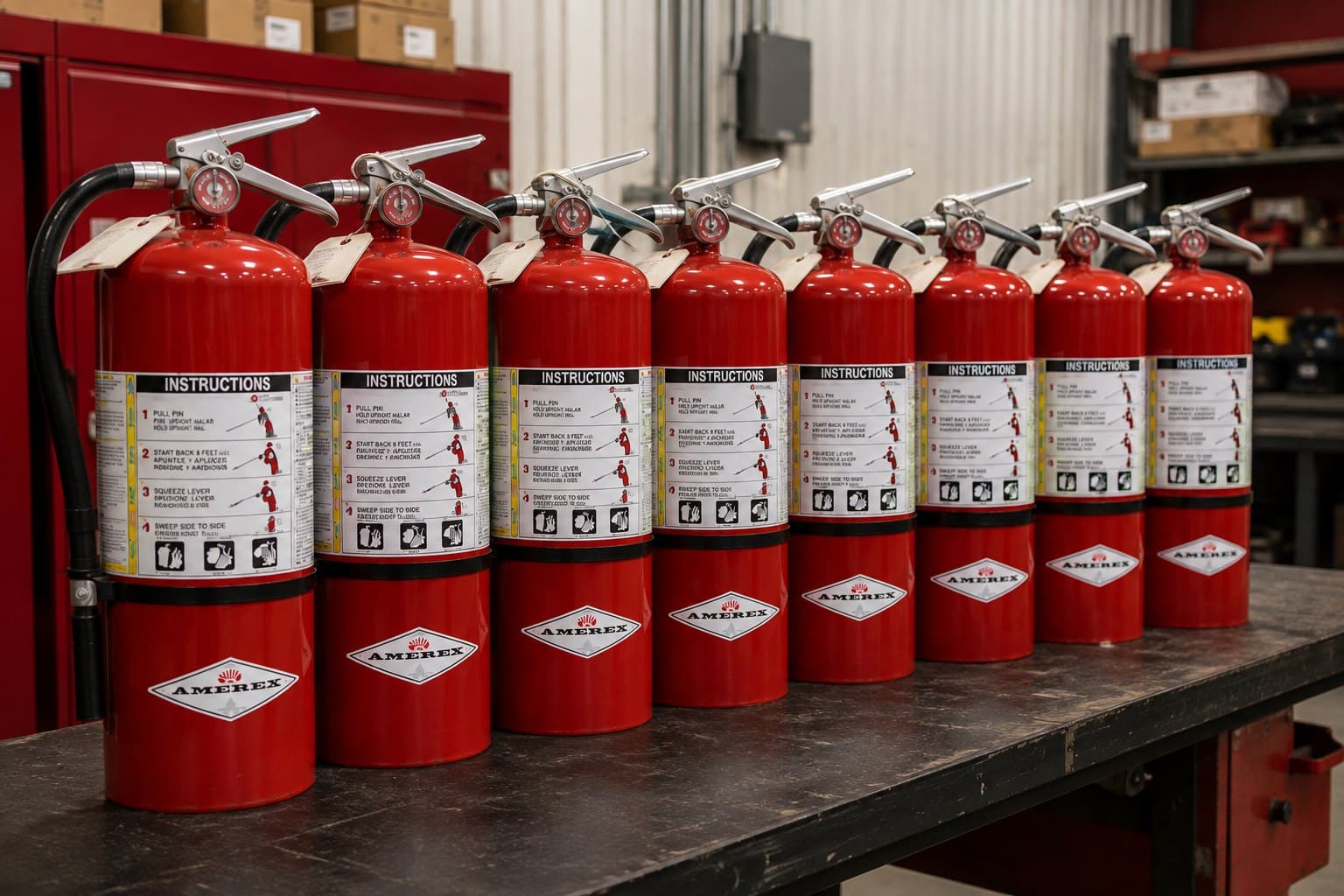
The building passes its inspection, the tags are current, and nobody has to think about it again until next year. That is the whole job, and it is the one line of work where our customer is usually not a fire chief: the restaurant on the highway, the school, the clinic, the plant, the church, and the city hall. The person we deal with is a facility manager or an owner.
This article explains the service clock behind that, what an annual visit actually covers, and how to set up a program if you have more than one building.
The clock: four intervals
Portable fire extinguishers are inspected and maintained on a schedule set by NFPA 10, the standard we cite on our extinguisher service page. Four intervals matter to a building owner.
Monthly: the visual check
Once a month, someone walks the building and looks at every extinguisher. It is in its place, it is visible and accessible, the gauge reads in the green, the pull pin and tamper seal are intact, and there is no visible damage or corrosion. This does not require a technician. A staff member can do it and initial the tag. If you would rather have a technician do the monthly walk, ask; it can be built into a program.
Annual: maintenance by a technician
Once a year, a trained technician examines each unit: mechanical parts, the agent, the hose and nozzle, the gauge, the cylinder, the bracket and mounting, and the placement against what the space needs. Units are recharged or repaired as needed, and every unit gets a dated service tag. This is the visit most people mean when they say "extinguisher inspection," and it is the one an inspector looks for.
Six-year: internal examination
Stored-pressure dry chemical extinguishers, which are most of what hangs in a commercial building, are emptied, opened, examined internally for corrosion and agent condition, and recharged every six years. A unit that fails the internal examination is condemned and replaced. This is the interval customers forget most often, because nothing about the extinguisher looks different at year six.
Twelve-year: hydrostatic test
Every twelve years the cylinder itself is pressure tested to confirm it can still safely hold its charge. Some types differ: carbon dioxide cylinders, for example, are hydrostatically tested every five years. We track the intervals by unit so you do not have to.
The six-year and twelve-year dates are the ones that turn a routine service into an emergency replacement when they are missed. A program that tracks them is worth more than the annual visit alone.
What an annual visit covers
The technician walks the building with your floor plan or with you, and for every unit:
- Confirms the unit is the right type and size for the hazard where it hangs. A kitchen needs a wet chemical unit for the cooking line. A server room may want a clean agent unit. A shop floor with flammable liquids needs a different rating than an office corridor.
- Inspects the cylinder, hose, nozzle, handle, pin, seal, and gauge.
- Weighs or gauges the unit to confirm the charge.
- Checks the bracket, mounting height, and that nothing blocks access.
- Checks the six-year and twelve-year dates and flags any unit coming due.
- Recharges, repairs, or replaces as needed, on site where the unit allows it.
- Tags the unit with the service date and technician, and records it.
You get a report listing every unit by location, type, size, condition, work done, and next due dates. Keep it. It is what you hand the fire marshal, the insurance inspector, or the health inspector when they ask.
Types we service
Dry chemical, carbon dioxide, foam, clean agent, and kitchen suppression units. Restaurants get particular attention because the hood system and the wet chemical extinguisher at the line are the two things a kitchen inspection always checks first.
Who calls us
Restaurants, schools, healthcare facilities, industrial plants, churches, offices, retail, municipal buildings, and fire departments servicing their own stations and the town's buildings. Many of them have more than one location.
Multi-location programs
A customer with several buildings, a school system, a chain of stores, a county with a dozen municipal buildings, does not want a dozen separate service dates. We set the program up as one account with one schedule: every location on the same cycle, one report, one invoice, and the six-year and twelve-year dates tracked across the whole inventory. The Fire Extinguisher Service page describes the program; the office sets it up on the first call.
What fails
The things we most often find on an annual visit, in a building that has not had regular service:
- Units past their six-year internal date, sometimes by years.
- Gauges in the red on units that were never noticed because nobody walks the building monthly.
- Missing tamper seals and pins, usually from a unit that was picked up and put back.
- The wrong type of extinguisher for the hazard, most often a dry chemical unit at a cooking line that needs wet chemical.
- Units mounted too high, behind a door, or in a closet nobody can reach.
- Units that have been discharged partially and returned to the bracket.
Every one of those is a failed inspection waiting to happen. Every one is simple to correct during a scheduled visit.
What to have ready
- A count and a rough floor plan. How many units, roughly where. We will inventory it exactly on the first visit.
- Existing tags. The last service date tells us where you are in the six-year and twelve-year cycle.
- Your inspection dates. If the fire marshal or an insurer is coming, tell us so the office can work the visit in ahead of it.
- Other locations. If you have more than one building, list them all so the program starts as one account.
Questions we get
Do you sell extinguishers, or only service them?
Both. We sell new units, including Amerex, and we place them as part of the visit when a building is short or has the wrong type. See our brands page for what we carry.
Can you service a business outside Monroeville?
We are based in Monroeville and serve businesses across the area, and we run multi-location programs across the state. Call the office with your locations and we will tell you straight.
What about the kitchen hood suppression system itself?
We service the portable wet chemical extinguisher at the cooking line. Hood suppression systems are a separate service. Ask us and we will tell you whether we can help or who to call.
Get on the schedule
Send us your unit count and your locations. Call the office at (251) 282-0958 or send a message, and Lynn will follow up to set a date.
Related service: Fire Extinguisher Service, Inspection, Repair & Sales