
Annual Fire Hose Testing: What Happens When We Come to Your Station
By Jason White, Owner · · 8 min read
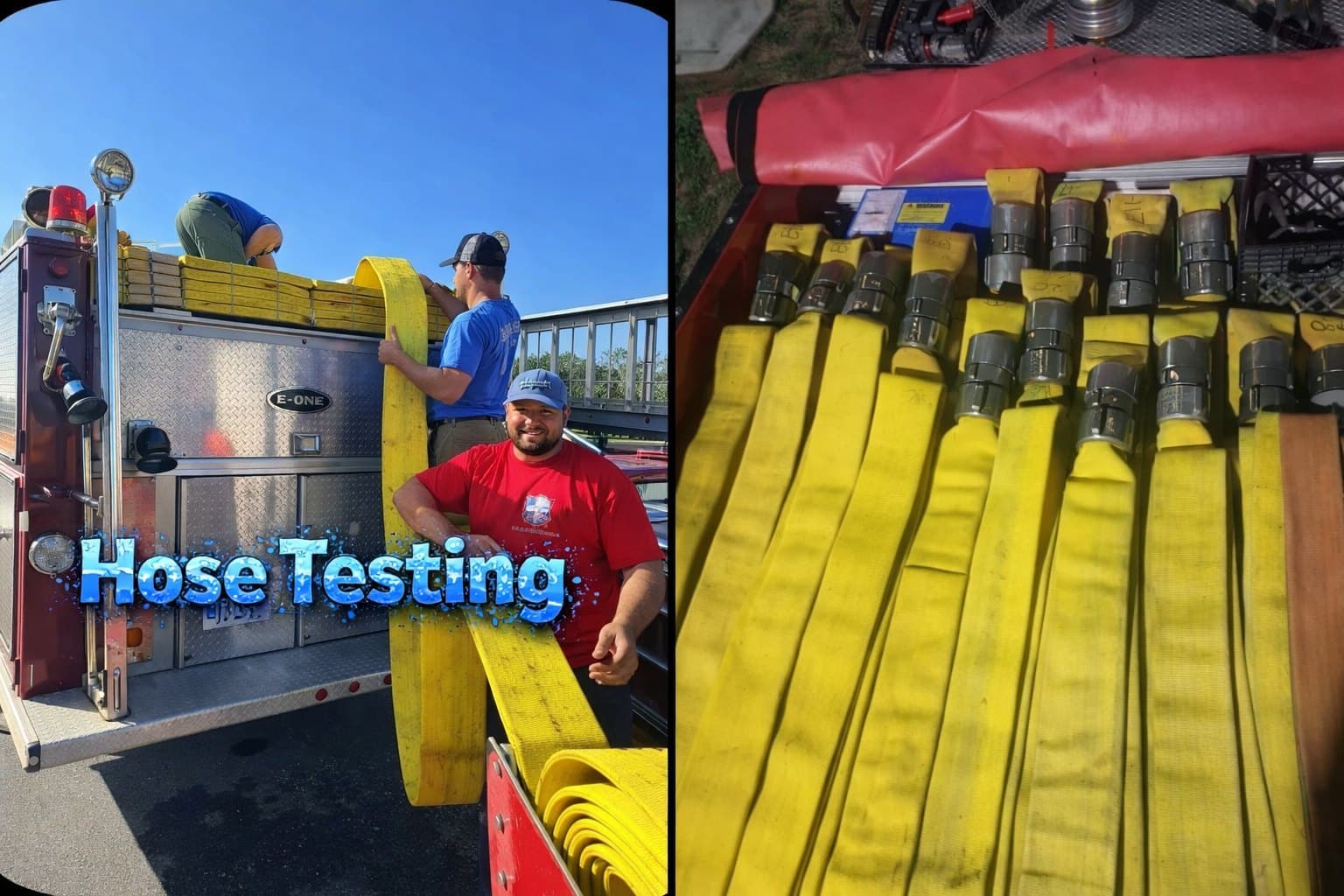
A section of hose does one thing. It holds pressure when somebody on the nozzle needs it to. Everything about the annual service test comes back to that one job, and the reason we do it on site, at your station, on your apparatus, is that hose lives on the apparatus and should be tested and reloaded there.
This is what the visit looks like from the time the crew pulls in until the last length is back in the bed. If you have never watched one, or you are a new officer who inherited the testing file, read this before you call.
Why every length gets tested every year
Hose fails in ways you cannot see from the outside. Liner separation, a coupling that has worked loose over a season, a gasket that has flattened, a jacket that got cooked on hot pavement or dragged over a curb. Under normal use, the line looks fine. Under pressure, it does not hold, and the moment you find out is the moment you least want to.
The annual service test puts every section under controlled pressure, with the crew standing clear, so that a weak length fails on a parking lot instead of on a fireground. That is the safety argument. The documentation argument is just as real: a department that can show a current hose test record for every length gets credit for it. A department that tested but cannot produce the record gets nothing.
We test to the standard as it is written for fire hose service testing, which is how it appears on our reports and on our hose testing service page: NFPA 1962. Two numbers from it matter to a chief. Attack hose is service tested to a minimum of 300 psi. Supply hose is service tested to a minimum of 200 psi. In both cases the test pressure does not exceed the service test pressure marked on the hose itself, so a length with a lower marking is tested to its marking. Pressure comes up gradually, the layout is checked, and then the test pressure is held for the required time with nobody near the line. There is no shortcut in that sequence and we do not take one.
What the crew does when we arrive
The order is the same at a two-engine volunteer station and a municipal department with a full fleet.
- Walk the apparatus with you. We look at how the hose is loaded on each apparatus: crosslays, the supply bed, preconnects, the bumper line, the high-rise pack. We note the lay patterns so the apparatus goes back together the way your crews train. If you have an apparatus you want left in service during the visit, tell us now and we work around it.
- Unload and stage by apparatus and by bed. Hose comes off in order and stays grouped. Nothing gets mixed between apparatus.
- Inspect before pressure. Every length gets a visual: jacket condition, couplings, swivels, gaskets, threads, and any old repairs. A length with an obvious problem gets set aside before it ever sees the pump. We also check that each length carries an identification number, because the record is per length, not per apparatus.
- Pressure test. Lengths are coupled into test layouts, filled, bled of air, and brought up to test pressure. The crew stands clear during the hold. A length that leaks at a coupling, weeps through the jacket, or fails outright is marked and pulled.
- Drain, sort, and document. Passed hose is drained and staged clean. Failed hose is tagged with what we found. Our technician records each length by ID, size, test pressure, and result.
- Reload. This is the step other vendors skip and it is the reason customers call us back. Hose goes back on the apparatus in the same lay, the same crosslays, the same supply bed configuration it came off with. Your crews should not be able to tell from the load that anyone touched it, except that it is clean and organized.
- Go over the results with you. Before we leave, you know what passed, what failed, and what we recommend for anything that failed. The written report follows.
Kenny Moss with Goodman Volunteer Fire Department put it plainly in a review on our site: the crew unloaded, tested, and reloaded all the supply hose and attack hose on the pumper and the tanker-pumper. That is the whole service in one sentence. Unload, test, reload, document.
What a real visit looks like
On August 10, 2026, Chalybeate Fire & Rescue in Lawrence County posted after our visit that we had tested over 7,950 feet of hose and 11 ladders across all of their engines and their rescue truck in a single day. They set up in a section of the East Lawrence Elementary School parking lot, which the school allowed them to use. That is a typical arrangement: a flat lot with a water source nearby, the apparatus lined up, and a department member on hand who knows the loads.
Frankie Phillips, another customer, wrote in a review that our crew tested 15 ladders and 8,500 feet of hose for his department in extreme heat. We put that on the home page because it describes the job as it is. Testing days are long and hot, and the crew works through them.
Those two are larger days than most. We plan the visit around your inventory, not around a fixed number, and a two-engine department is set up the same way.
Testing runs all year, not just in summer
Chiefs sometimes wait for warm weather to book hose testing because it is outdoor water work. We test year-round. Cold mornings are fine: the crew has the gear, the water drains, and a winter test date means your certificate is current before the spring brush season and well before your rating review.
The practical point is that the best month to test is the month before your last certificate expires. Anything later than that is a gap in the file.
What to have ready before the crew arrives
You do not need to prepare much, but these six things make the day go faster.
- A water source. A hydrant at or near the station, or a tanker that can supply the test pump. Tell us which one when you book so we bring the right adapters.
- A flat place to lay out hose. A parking lot, a slab, or a closed street. Enough room to stretch test layouts and keep the crew clear of the pressurized line.
- Your hose count. Roughly how many lengths of each size, by apparatus. It does not have to be exact. It tells us how many technicians to send.
- Someone who knows the loads. A driver, an engineer, or an officer who can confirm how each bed is supposed to be packed. We photograph and note the loads ourselves, but a crew member on hand settles questions in seconds.
- Anything repaired or in storage. Recoupled lengths, spare hose in the bay, hose that came off a retired apparatus. If you want it tested and documented, have it out.
- Coverage for the apparatus. An apparatus is out of service while its hose is off. Most departments arrange mutual aid coverage or stagger the apparatus. We can test one apparatus at a time if you need an engine in service all day.
What happens to hose that fails
A failed length gets tagged and pulled from the load. It does not go back on the apparatus. Our report lists it by ID with the reason: coupling leak, jacket failure, burst, or a visual defect found before pressure. Where a repair makes sense, for example a coupling that needs replacing on an otherwise sound length, we say so. Where the length should be retired, we say that instead.
Then it is your call. We can quote replacement hose through our equipment sales side, and we carry hose, nozzles, and appliances from the manufacturers on our brands page. We do not bundle a sale into the test. The report stands on its own.
The paperwork, and why ISO cares
The report you receive lists every length tested, its identification number, size, the test pressure used, and pass or fail. Keep it with the hose inventory. When your community's rating is reviewed, annual hose test records are among the documents evaluators ask to see. They credit what is documented. A verbal account of testing done last spring is not documentation.
If your department has never kept a per-length inventory, the first visit builds it. Every length gets an ID if it does not already have one, and from that year on the record carries forward.
Questions we get
Do you test hose on a volunteer department with two trucks?
Yes, and it is the same crew, the same test, and the same report as a municipal fleet. There is no minimum. Read the Wagarville and Pintlala reviews on our home page if you want to hear it from departments that size.
Can you do the ladders on the same visit?
Yes. Most departments book hose and ground ladders together, which is why we wrote a separate article on ladder testing. One visit, both records.
How far do you travel?
We are based in Monroeville, Alabama, and work with departments across the state and the Southeast. Call the office with your location and we will tell you straight whether and when we can get to you.
Get on the schedule
If you know the month your hose was last tested, you know when it is due. Call the office at (251) 282-0958 or send a message with your department name, your apparatus count, and the last test date, and Lynn will follow up to set a date.
Related service: Fire Hose Testing