
Ground Ladder Testing: What the Test Proves and Why We Do It With Your Hose
By Jason White, Owner · · 6 min read
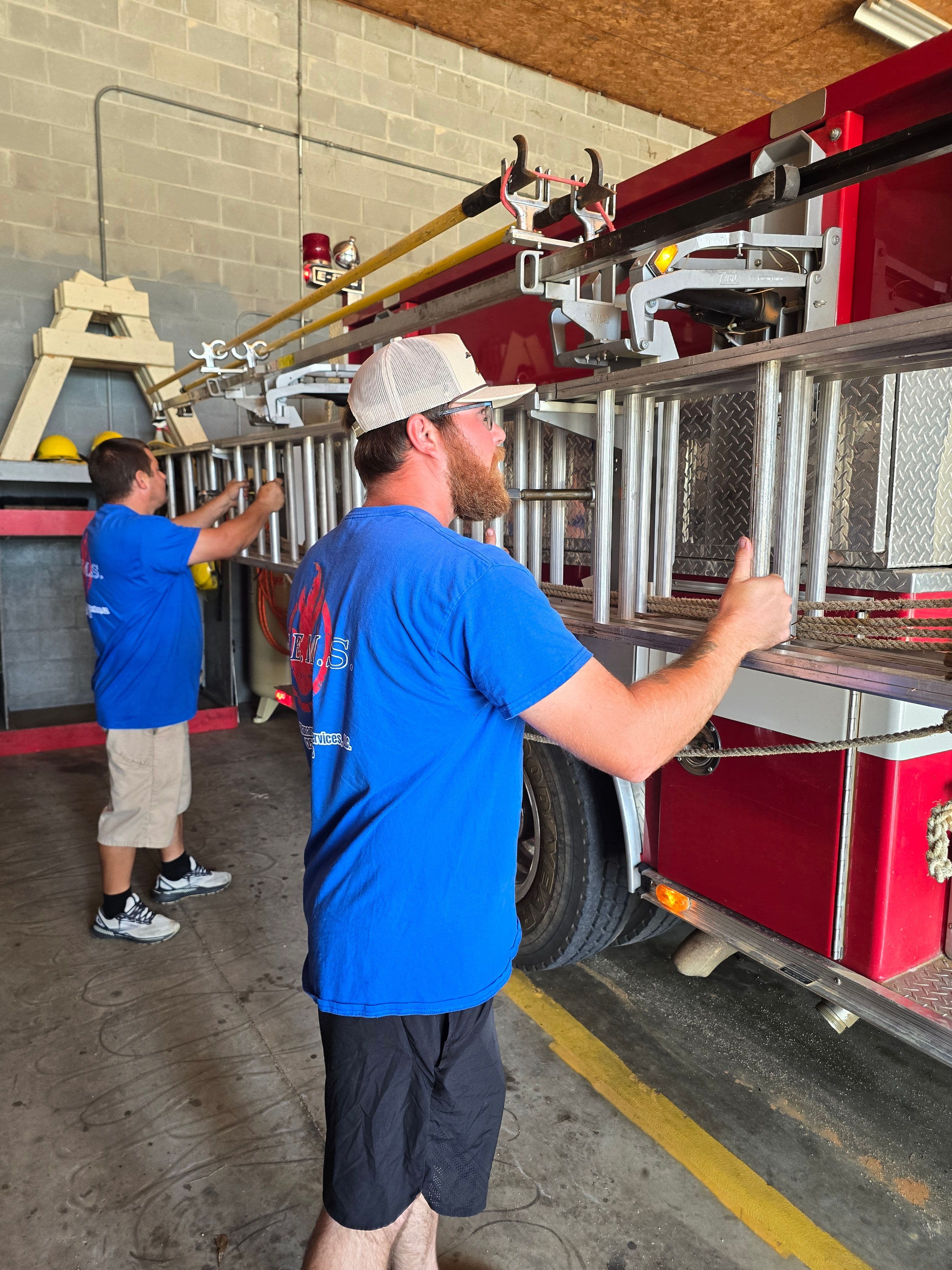
A ground ladder is the piece of equipment on the apparatus that a firefighter trusts with their whole body weight, usually at the worst possible moment, often in the dark. It does not have a pressure gauge. It does not throw a fault code. The only way to know that a ladder will hold is to load it, on the ground, under controlled conditions, once a year, and to look closely at the parts that fail quietly.
That is what the annual service test does. We perform it on site, on the same visit as your hose testing, and the ladders go back on the apparatus exactly where they came off. This article covers what we check, what the results mean, and what you should have ready.
What the standard asks for
We test ground ladders to the standard as it appears on our reports and on our ground ladder testing service page: NFPA 1932, which covers the use, maintenance, and service testing of in-service fire department ground ladders. It calls for a service test at least annually, and again any time a ladder has been through something that could have damaged it: a fall, an overload, exposure to high heat, or a hard impact.
Four parts of the test matter most to a chief reading the report.
- The horizontal bending test. The ladder is supported near each end, a test load is applied at the center, and the ladder has to carry it for the time the standard specifies without permanent deformation. For the common roof, extension, and combination ladders, that load is 500 pounds. We measure deflection before and after, and a ladder that does not return to within its allowed tolerance fails.
- The roof hook test. Roof ladder hooks are loaded to confirm they will hold the ladder in place on a pitched roof. A hook that is bent, cracked, or loose at the pivot is a failure by itself.
- Hardware and component inspection. Pawls, halyards, pulleys, rung connections, beam condition, stops, tie rods, and the spurs. A frayed halyard or a pawl that does not seat cleanly gets written up.
- Heat sensor labels. Every ladder carries heat sensor labels on the beams. They are preset to change color at 300 degrees Fahrenheit. A label that has tripped means the ladder was exposed to heat that can weaken aluminum without leaving a visible mark. That ladder is removed from service and gets the full structural evaluation, not a quick look.
What we actually see fail
Ladders do not fail the bending test very often. What they fail is the inspection before the bending test.
- A roof ladder with hooks that have been bent by being stored under something heavy.
- An extension ladder with a halyard that has been re-tied by hand after it broke, so the fly section does not lock at the right height.
- A tripped heat sensor label on a ladder that went to a working fire two years ago and was put back on the apparatus without anyone noticing.
- Rungs that are loose at the beam, which you can hear before you can see.
- Missing or damaged spurs and butt plates, which change how the ladder sits on pavement.
None of those show up when the ladder is sitting in its bracket. They show up when a technician has it on the ground, in daylight, working through the checklist.
Why hose and ladders go on the same visit
Both tests need the apparatus staged, the equipment off the apparatus, and a crew that knows how it all goes back. Doing them together means one visit out of service instead of two, one report cycle, and one date to remember.
It is also the way most of our customers already do it. Curt Pechloff wrote in a review on our home page that his department hired us for both ladder and hose testing and was pleased enough with the crew's work to recommend us to other chiefs. Chalybeate Fire & Rescue's own post after our August 2026 visit counted 11 ladders alongside nearly 8,000 feet of hose in the same day.
What the crew does
- Walk the apparatus. We note where every ladder lives: the roof ladder in its bracket, the extension in the rear compartment, the attic ladder in the officer's side. Mounting positions are photographed and recorded so they go back exactly.
- Unload and label. Each ladder is identified by type and length and tied to its apparatus.
- Inspect. The full visual: beams, rungs, hardware, hooks, halyards, labels, and any evidence of heat or impact.
- Load test. The horizontal bending test on every ladder, and the roof hook test on every roof ladder. Deflection is measured and recorded.
- Document. Each ladder is recorded with its result. A failed ladder is tagged and set aside with the reason.
- Reload. Every ladder returns to the mounting position it came from. Your crews reach for a ladder without looking. It has to be where their hands expect it.
What to have ready
- Your ladder inventory by apparatus. Type and length. If a ladder has no identification, the first visit assigns one.
- A flat area with room to work. The bending test needs the ladder supported at both ends with space around it.
- Any ladder that has been through a hard event. A fall, a heat exposure, a vehicle strike. Tell us before we start so it gets the full evaluation.
- Spare or stored ladders. Ladders in the bay that are not mounted still get tested if you want them documented for use.
When a ladder fails
A ladder that fails the load test, has a tripped heat sensor, or has structural damage is removed from service. Our report says why. Some hardware issues can be corrected, a halyard replaced, a pawl assembly repaired, and we say so when that is the case. A cracked beam or a ladder that took a permanent set under load is retired, and we say that too. When a ladder's structure is compromised there is usually no repair that a chief should trust a firefighter's weight to, so a structural failure almost always means a retired ladder.
Replacement ladders are available through our equipment sales side. The test report never depends on whether you buy anything from us.
The record and the rating
Your report lists every ladder by apparatus, type, and length, with the inspection findings, the load test result, and any recommendation. Keep it with the hose test records. When your community's rating is reviewed, documented equipment testing is what earns credit. Evaluators credit what you can hand them.
Questions we get
Do you test aerial ladders?
This article and our service page cover ground ladders. If you have an aerial device that needs its annual test, call the office and we will tell you what we can do and what we would refer out.
How often do heat sensor labels need replacing?
Labels are replaced when they have tripped, when they are missing, or when they are no longer readable. We check every one and note replacements on the report.
Can we keep the engine in service while you test?
Yes. We can test one apparatus at a time so you keep coverage, or you can arrange mutual aid for the day. Tell Lynn when you book and we plan the sequence around it.
Get on the schedule
If your hose is coming due, your ladders are too. Call the office at (251) 282-0958 or send a message with your department name and apparatus count, and Lynn will follow up to set a date for both.
Related service: Ground Ladder Testing